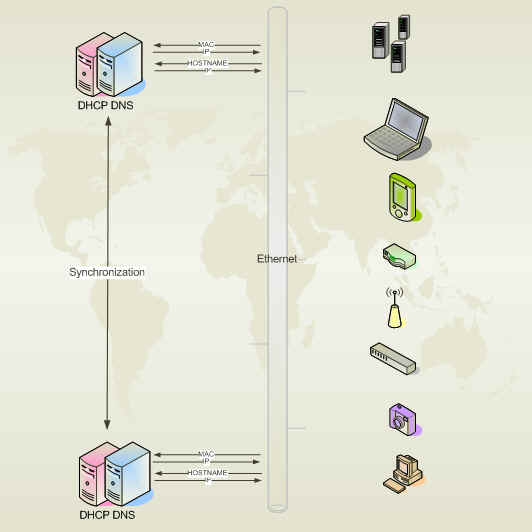
Dual DHCP DNS Server
Dual Server is Self Integrated DNS Server Open Source Freeware for Windows/Linux. It has build in Optional DHCP Server.
DHCP Server allots the IP
addresses to computers, while DNS server resolves them. You need
DHCP Server if you do not want to manually maintain IP Addresses or you
have less IP Addresses than number of machines you have, as dynamic DHCP
Server will recycle IP Addresses on machines.
DNS Server is needed
for resolving hostnames to their IP addresses. Normally your ISP will
provide you with DNS Service. You may have your own DNS Server, which will
resolve hostnames by forwarding them to ISP's DNS Server and cache the
addresses also.
If you have home/small office network with
Unix/Linux machines, these machines will not be resolved from each other,
as Unix/Linux machines do not support NBNS protocol and you need your own
DNS Server. But how about resolving your local machines ?. Your ISP's DNS
Server will not have this list and your own DNS Server wont have them
either. Most DNS Servers cannot do this.(unless you configure dynamic
updates, or use static IP addresses and manually enter them).
This
server resolves dhcp alloted local machines automatically in addition to
external hosts, with the added advantage being both dhcp and dns server
are allways in sync. Also there is no need to create and maintain
cumbersome zone files. Dual DHCP DNS Server is an Open Source Freeware. In
addition, this server is designed for Load Sharing Replicated
Operation
DNS Features include Forward and
Reverse Lookup, Zone Transfer, Primary/Secondary Mode of Operation, MX
Records, Wildcard Records, Conditional and Default forwarding.
DHCP
Fearures support Static and Dynamic 125 DHCP Ranges, Range Filters, Relay
Agents and BOOT, Options can be specified for DHCP Ranges, Global or for
Static Hosts.
Either DHCP or DNS Service can be used. If both
services are used, DHCP allotted hosts are automatically added in DNS
zones.